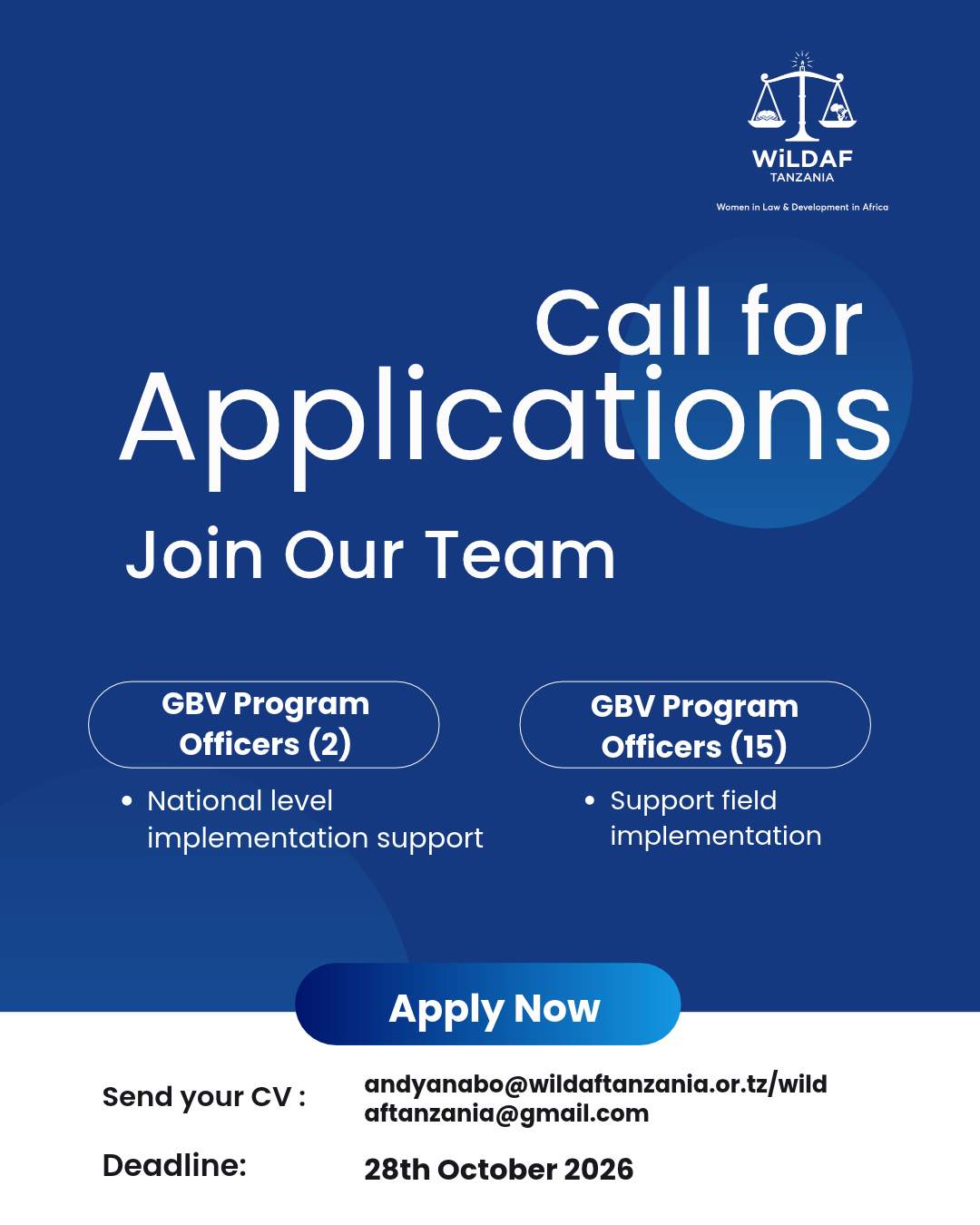
Call for Application
TERMS OF REFERENCE
1.0 BACKGROUND
Women in Law and Development in Africa (WiLDAF) is a Pan-African network established in February 1990 in Harare, Zimbabwe. With a presence in 26 countries, the network brings together more than 350 organizations and 3,000 individual members. Established in Tanzania in 1997, WiLDAF Tanzania works across Mainland Tanzania and Zanzibar to advance women’s human rights, gender equality and sustainable development through law, networking, movement-building and advocacy.
WiLDAF’s vision is a just society that embraces gender equality and women’s rights. Its mission is to enhance women’s empowerment and equality through law, networking and advocacy in all aspects of development.
Gender-based violence (GBV) is rooted in unequal power relations, gender discrimination and social, institutional and structural norms that deny women and girls their rights, bodily autonomy, safety and equal participation in public and private life. Effective prevention therefore requires more than awareness-raising: it calls for feminist, rights-based and survivor-centred approaches that challenge the conditions that enable violence, strengthen accountability, and support survivors to access timely, accessible and quality services without stigma or discrimination.
WiLDAF Tanzania invites qualified and experienced professionals to submit their CVs for consideration for potential positions under a proposed programme focused on preventing and responding to GBV in Mainland Tanzania. The programme is expected to strengthen community-based prevention, transform harmful gender norms, promote gender justice and equality, and reinforce local systems for prevention, protection, referral and accountability. This call is intended to establish a pool of suitable candidates who may be considered for recruitment, subject to programme approval and funding availability; it does not constitute a guarantee of employment.
2.0 PURPOSE OF THE CALL
The purpose of this call is to identify qualified professionals with the technical expertise, practical experience and feminist commitment required to support the design, coordination and implementation of GBV prevention and response interventions at national and community levels. Candidates should demonstrate the ability to analyse and address unequal power relations, promote women’s and girls’ agency, work in solidarity with affected communities, and uphold the rights, choices, dignity and safety of survivors.
3.0 POSITIONS AND REPORTING LEVELS
Position 1: GBV Programme Officers – National-Level Implementation Support
Number of positions: 2
Position 2: GBV Programme Officers – Field Implementation Support
Number of positions: 15
The specific duty stations, reporting lines, geographic coverage and terms of engagement will be confirmed during recruitment and in accordance with the approved programme structure.
4.0 KEY RESPONSIBILITIES
4.1 GBV Programme Officers – National-Level Implementation Support
The national-level officers will provide technical, coordination and implementation support to ensure that programme interventions are evidence-informed, feminist, rights-based, inclusive, survivor-centred and aligned with relevant national frameworks and donor requirements. Responsibilities will include:
- Provide technical input into the design, planning, coordination and implementation of comprehensive GBV prevention and response interventions, grounded in gender and power analysis and women’s human rights.
- Support the development and adaptation of implementation plans, operational guidance, tools, referral protocols and programme frameworks that promote survivor safety, agency, informed choice and access to justice.
- Coordinate with relevant government institutions, local government authorities, civil society and women’s rights organizations, organizations of persons with disabilities (OPDs), development partners and other stakeholders, while supporting meaningful participation and accountability.
- Provide technical support for feminist social and behaviour-change interventions that challenge discriminatory gender norms, patriarchal power relations, victim-blaming, stigma and practices that normalize or excuse violence.
- Promote the meaningful leadership and participation of women and girls, including those with disabilities and those facing intersecting forms of discrimination, in programme design, implementation, monitoring and learning.
- Ensure gender equality, disability inclusion, safeguarding, child safeguarding where relevant, and survivor-centred principles are integrated across programme activities and partnerships.
- Provide coaching and technical guidance to field-based officers, implementing partners, community structures and frontline service providers, including on safe identification, ethical engagement and referral in line with established pathways.
- Review implementation data, qualitative evidence and performance indicators to assess progress, identify gaps and support adaptive management without compromising confidentiality or survivor safety.
- Identify operational, contextual and protection risks; recommend practical corrective actions; and escalate safeguarding concerns through established procedures.
- Contribute to donor reports, policy and advocacy products, case studies, learning products and documentation of promising practices, ensuring that survivor stories and data are used ethically and with informed consent.
- Support monitoring, evaluation, accountability and learning processes, including feedback and complaints mechanisms that are safe, accessible, confidential and responsive to community priorities.
- Promote compliance with relevant national laws and policies, applicable safeguarding and data-protection standards, programme commitments and donor requirements.
4.2 GBV Programme Officers – Field Implementation Support
Field officers will support day-to-day implementation of community-based GBV prevention and response activities in collaboration with local authorities, women’s rights actors, community structures and service providers. Responsibilities will include:
- Facilitate community-led prevention activities and dialogues that examine unequal power relations, gender discrimination, harmful social norms and the root causes of GBV.
- Engage women and girls as rights-holders and agents of change, while working strategically with men and boys, community leaders, religious and traditional leaders, youth groups and other actors to challenge violence and advance gender justice.
- Support social and behaviour-change initiatives that promote consent, bodily autonomy, respectful relationships, non-violent practices, shared responsibility and women’s equal participation in decision-making.
- Coordinate with local government authorities, community-based organizations, women’s rights organizations, OPDs and frontline health, psychosocial, legal and protection service providers.
- Identify barriers that prevent survivors and at-risk groups from accessing services, including stigma, cost, distance, inaccessible facilities, discrimination and fear of retaliation, and communicate these barriers through appropriate programme channels.
- Provide information on available services and facilitate safe, timely and confidential referrals in accordance with established referral pathways, informed consent and survivor-centred principles. Officers must not investigate cases or pressure survivors to disclose or pursue a particular course of action.
- Facilitate community training, outreach, awareness campaigns and capacity-strengthening activities using accessible, age-appropriate and context-sensitive methods.
- Promote the meaningful participation of women, girls, persons with disabilities and other groups experiencing marginalization, ensuring activities are accessible and responsive to diverse needs.
- Collect and submit accurate, timely and disaggregated programme data using approved tools, while observing data minimization, confidentiality, informed consent and safe information-management practices.
- Monitor field activities and document progress, emerging needs, risks, challenges and community feedback; promptly report safeguarding concerns in accordance with established procedures.
- Support the appropriate use of information, education and communication materials and other programme resources, ensuring messages do not stigmatize survivors or reinforce harmful stereotypes.
- Participate in supervision, monitoring visits, review meetings and capacity-building activities, and contribute to reflection, learning and continuous improvement.
5.0 MINIMUM QUALIFICATIONS AND EXPERIENCE
5.1 National-Level Implementation Support
- Master’s degree in Gender Studies, Gender and Development, Sociology, Social Work, Human Rights, Development Studies or another relevant field.
- Demonstrated experience in at least two comparable projects implemented within the past ten years, covering GBV prevention and/or response, gender equality, social norms transformation or large-scale community-based programming.
- Demonstrated understanding of feminist, human-rights-based and survivor-centred approaches, including the structural drivers of GBV and intersecting forms of discrimination.
- Experience in programme coordination, technical guidance, partner engagement, monitoring and reporting.
- Experience in donor-funded programmes is desirable; experience with World Bank-funded projects will be an added advantage.
5.2 Field Implementation Support
- Bachelor’s degree in Gender Studies, Gender and Development, Sociology, Social Work, Community Development or another relevant field.
- Relevant practical experience in GBV prevention and/or response, gender equality programming, community mobilization, social norms transformation or community-based development.
- Experience working with local government authorities, community structures, women’s rights organizations, OPDs, frontline service providers or donor-funded projects is an advantage.
- Demonstrated commitment to women’s human rights, gender equality, confidentiality, non-discrimination and survivor-centred practice.
6.0 REQUIRED TECHNICAL COMPETENCIES
- Feminist and gender analysis: Ability to analyse structural inequalities, patriarchal power relations, harmful gender norms and the ways gender intersects with disability, age, poverty and other forms of exclusion.
- GBV prevention and response: Understanding of the forms, drivers and consequences of GBV and of evidence-informed, rights-based prevention and response approaches.
- Community engagement and facilitation: Ability to facilitate inclusive, participatory and context-sensitive dialogues, training and collective action without reinforcing victim-blaming or harmful stereotypes.
- Survivor-centred practice: Understanding of safety, confidentiality, respect, non-discrimination, informed consent, survivor agency and the right of survivors to make their own decisions.
- Referral and service coordination: Knowledge of local referral pathways and the ability to support safe access to health, psychosocial, legal and protection services within the limits of the role.
- Disability inclusion and intersectionality: Ability to identify and address access barriers and promote reasonable accommodation, accessible communication and meaningful participation.
- Safeguarding and ethical conduct: Understanding of safeguarding, prevention of sexual exploitation, abuse and harassment, child safeguarding where relevant, safe disclosure and appropriate reporting procedures.
- Monitoring, evaluation, accountability and learning: Ability to collect and interpret programme data, document results, use community feedback and support adaptive implementation.
- Communication and collaboration: Strong facilitation, writing, coordination, problem-solving and relationship-building skills, including respectful engagement with diverse stakeholders.
7.0 CORE VALUES AND PROFESSIONAL STANDARDS
- Uphold women’s and girls’ human rights, dignity, agency, bodily autonomy and right to live free from violence.
- Apply a feminist, intersectional and rights-based lens that recognizes structural inequality and avoids treating GBV as an individual or isolated problem.
- Respect survivors’ choices and never pressure, blame, stigmatize or discriminate against a survivor, or promise outcomes that cannot be guaranteed.
- Maintain confidentiality and share sensitive information only when authorized, necessary and consistent with established safeguarding and data-protection procedures.
- Obtain informed consent before collecting or using personal information, photographs, quotations or personal stories, and explain the purpose and limits of confidentiality in accessible language.
- Recognize the limits of the role: do not investigate allegations, mediate cases of violence where this could place survivors at risk, or provide services beyond one’s competence.
- Demonstrate accountability, integrity, cultural humility and respectful collaboration with communities and partners.
8.0 APPLICATION REQUIREMENTS
Interested candidates should submit the following documents:
- Application letter stating the position applied for, relevant qualifications, experience and suitability for the role.
- Updated curriculum vitae (CV) outlining academic qualifications, relevant professional experience, key assignments, technical skills and contact details for at least three professional referees.
- Brief description of relevant project experience in GBV prevention and/or response, gender equality, social norms transformation or community-based programming. Candidates may include their specific role and key contributions.
9.0 APPLICATION SUBMISSION
Applications should be submitted by email to andyanabo@wildaftanzania.or.tz/wildaftanzania@gmail.com no later than 28 October 2026. Applicants should clearly indicate the position applied for in the email subject line.
This is a call to establish a pool of qualified candidates for potential recruitment under a proposed programme. Any appointment will be subject to programme approval, funding availability, verification of qualifications and references, and WiLDAF Tanzania’s recruitment and safeguarding procedures.
10.0 EQUAL OPPORTUNITY AND SAFEGUARDING
WiLDAF Tanzania is committed to equality, dignity, inclusion and safe working environments. Applications from women, persons with disabilities and candidates with relevant lived, community or professional experience are encouraged. All candidates are expected to uphold WiLDAF’s values and applicable safeguarding, anti-harassment, child-protection and data-protection standards. Any appointment will be subject to relevant reference and background checks, consistent with applicable law and organizational procedures.